Tuesday, July 30, 2024

The Byron Band - On The Rocks ... Again

From 1969 to 1976 Uriah Heep released ten albums with David Byron as lead vocalist (he also released a solo album in 1975).  Next up he recorded one eponymous album with the short-lived blues rock band Rough Diamond whose membership included former Colosseum and Humble Pie guitarist Clem Clempson and former Wings drummer Geoff Britton.  In 1978 he released his second solo album, which was co-written and co-produced by pop artist Daniel Boone, and was a shift in direction with its more synth heavy sound and tracks running the gamut from pop and rockabilly to glam and disco.  After signing with the reggae label Creole Records, he and Boone co-wrote his next single “Every Inch Of The Way”.  Boone was also working with Robin George at the time and suggested he should mix it (George would go on to have success as a solo artist, worked with Phil Lynott on his final works and collaborated in various projects with Sean Harris, Glenn Hughes, Pete Way and Spike).  After a successful meeting they started working together which resulted in the formation of The Byron Band and their one album On The Rocks, which is the focus of this new three-CD box set.  The remaining members of the band were Mel Collins (Camel, King Crimson) on sax, Bob Jackson (Badfinger) on keyboards, Roger Flavelle on bass and John Shearer on drums.  In addition to the album, this box set includes the aforementioned non-album single, tracks recorded for a proposed second album, writing demos, recordings from a rehearsal session and a live performance recorded in Liverpool in 1980.

The album opens strongly with “Rebecca”, a straight-ahead rocker with a hint of honky-tonk tinged blues, and the sleazy blues rock of “Bad Girl”. “How Do You Sleep”, at just under six minutes, is one of the album standouts and really showcases the band’s musicianship.  It has a lot of dynamics, shifting between slower kind of taut and dark sections, heavier, really powerful sections, and mellower, almost ballad-like sections with great guitar work from George and some really nice horn accents.  Following the soulful, laid-back “Little By Little” is “Start Believing”, which starts with some really catchy guitar from George, leading into a rocker with a bit of a funk beat.  It has a super infectious groove and the guitar work, as always, is top notch with some nice keyboard accents and a little sax.  The next two cuts are the album’s weakest.  “Never Say Die” is pretty much a standard midtempo AOR track with a bit of a boogie woogie beat, while “King” is a bit quirky with lyrics that are almost novelty and simplistic.  Having said that it has some great guitar work that shows glimmers of what was to come on George’s debut solo album a few years later.  Closing the album is the killer epic tune “Piece Of My Love”, which opens with a two-minute instrumental section that’s kind of dreamy with elements of jazz and blues and a mournful horn, then shifts into a solid bluesy rocker with a boogie woogie beat.  The first disc also includes seven bonus tracks starting with the straight-ahead Eighties rocker “Fool For A Pretty Face” and the outstanding, extremely catchy, hard-charging rocker “Safety In Numbers”.  It’s a shame this latter track never got released, because it has hit written all over it.  “One Minute More” is a slightly bluesy power ballad, with a hint of “Free Bird” at times, that really showcases Byron’s vocals.  “Every Inch Of The Way”, the aforementioned single that led to the meeting of Byron and George, is included here in the single version as well as a longer version, and is a bouncy boogie-woogie tune with some great honky tonk piano.  The single’s flipside was “Routine”, which is really quite unlike anything else they did and is personally one my favorites.  It’s a crazy, offbeat track driven by a massively infectious beat, blasting horns, stellar guitar from George (including some sounding like sirens), layered vocals and harmonies and more.  Why this was relegated to the b-side of a one-off single is beyond me.  Another b-side (this one for their “Rebecca” single) is “Tired Eyes,” a gorgeous ballad that’s primarily Byron’s vocals accompanied by George’s acoustic guitar.  

Disc two is devoted to the demos that were recorded for what was intended to be their second album.  The first six are full band demos recorded at DJM Studios in London.  Alongside great sounding takes of three of the songs that are bonus tracks on disc one (“Fool For A Pretty Face”, “Safety In Numbers” and “One Minute More”) are the heavy on the funk rocker “Learn The Dance” and the straight-ahead rock of “I Need Love”.  There is also a demo of “Bad Girl”, a song that was included on the On The Rocks.  The second half of the disc contains songwriting demos, written at David’s house, that are largely just over or under a minute, and are just him on vocals and Robin on acoustic guitar, along with the occasional studio banter (a handful of them only exist in these short snippets). They give an interesting insight into the basic foundation of what can be heard elsewhere here in its entirety.  

Rounding out the box set on disc three are a couple of live recordings. First up is a rehearsal from 1981 that was recorded on a tape recorder so they could listen to their progress before going on tour.  While it definitely sounds more like a bootleg, considering it was recorded on a tape recorder, the sound quality is really good and stands up to repeat listens.  Along with two cuts from the first album, and a couple more that were demo’d for the second, are “Goodnight Blues” and “Last Chance Jam”, which don’t appear elsewhere.  The other live set was recorded in Liverpool in 1980 and along with four On The Rocks tracks contain Uriah Heep’s “July Morning” and “Sweet Lorraine” (both of which sound great with this band), the previously unheard “Liverpool Blues” and a cover of “Roll Over Beethoven”.  Byron’s vocals are in fine form, the band sounds great and along with the crowd it sounds like everyone had a fantastic time.  As with the first set, the recording is a little rough, but really quite good considering it’s not professional.  The disc closes with “Angelsong”, a touching, very melancholy song that Robin originally released in 1985 and said was a tribute to Byron, Phil Lynott, and other musicians with whom he’d collaborated over the years.  Also included is a very informative booklet with a lot of insight from Robin about his time working with David.  Sadly, David passed away in 1985 from alcohol related complications and Robin left us just a few months ago in April.  

(HNE Recordings)

Monday, July 08, 2024

Carmen - The Albums 1973-1975

Carmen originally formed in LA in 1970 as a seven piece and was the brainchild of David Clark Allen, the child of flamenco performers who had himself been trained as a flamenco guitarist.  Over the next few years, twelve different musicians made their way through the band before they became a quintet in 1972.  While all the labels in LA loved their live performances, they felt it was impossible to get their sound recorded, so they ended up moving to London thinking they would have a different opinion.  It should be noted that in their live show they used vocalists Roberto Amaral and Angela Allen as flamenco dancers, and they also used an amplified floor to utilize their dancing as percussion.  Initially rounding out the band were brothers Brian and John Glascock on drums and bass respectively (both had previously played in pre-Uriah Heep band The Gods and Toe Fat, and John later played for a short while in Jethro Tull before passing away at 28).  Upon moving to London, they made a very influential friends with David Bowie and Tony Visconti, but unfortunately Brian had decided not to make the move and was replaced by Paul Fenton.  While Visconti ended up producing their first two albums, the friendship with Bowie resulted in them being his guests in a show at the Marquee in London from October 18-20, 1980, called The 1980 Floor Show.  It featured his final appearances as Ziggy Stardust and ended up being broadcast in the US on the Midnight Special TV show.  From 1973 to 1975 they released three albums that to this day contain some of the most unique music out there, meshing rock and prog with flamenco, dance and more.  Their new three CD box set, The Albums 1973-1975, collects these three albums, as well as four bonus tracks.  

Their debut album, Fandangos In Space, was produced by Visconti and opens with "Bulerias", a track that is the epitome of what they are about.  It's a three-part song that is the perfect merging of flamenco rhythms, prog guitar sections with castanets weaving in and out and foot stomping percussion.  The extremely catchy "Bullfight" continues in that vein, but also adds synths to the mix and has great stop and start, fast and slow tempo shifts.  They slow things down a little on “Stepping Stone”, which has a spacy, psychedelic sound and a bit of a laid-back funk beat, while “Sailor Song” is more of a folk-rock track with some elements of prog.  “Lonely House” is a fairly straightforward acoustic ballad with some really nice Spanish flavored acoustic guitar.  David showcases his guitar work on the acoustic instrumental “Por Tarantos” which isn’t quite straight up flamenco, but definitely has flourishes of it.  “Looking Outside (My Window)” ups the ante in the rock department starting off quite heavy and then shifting back and forth between slower, acoustic guitar driven sections and heavier sections with even more emphasis on flamenco, including some handclaps.  At just under nine minutes, “Tales of Spain” is somewhat of a prog suite that’s constantly shifting, twisting and turning in multitude of different musical styles, starting out slow and very reminiscent of the west coast sound with some great vocal harmonies, then moving into spacey spoken word storytelling, upbeat rock, psychedelia and much more.  It’s followed by “Retirando”, a gorgeous Spanish flavored track that at only forty-eight second still really impresses with its harmonies (interestingly some places on the internet show the end of “Tales of Spain” as actually being the beginning of this song making it almost a minute and a half longer).  The title track is up next and is another complex tour de force with a melodic prog intro leading into more of a flamenco section and then an almost frantic, jazzy instrumental middle section and then back into prog.  It also has some great guitar work and incredible vocal harmonies, including some falsetto and choral sections, that have a Queen vibe if they had had a Spanish flamenco influence.  Closing out the album on a mellow note is “Reprise/Finale”, a short acoustic Spanish guitar driven instrumental.

Album number two, Dancing on a Cold Wind, was once again produced by Visconti, and opens with “Viva Mi Sevilla”, probably the heaviest, and arguably the best, track they ever released.  After starting with an acoustic Spanish guitar, a fuzzy, thumping bass comes in along with foot stomping percussion.  As it evolves, killer electric guitar kicks in and then it shifts to heavy Spanish flavored prog rock before closing with a powerful instrumental section that includes keys and some pummeling cowbell.  Angela steps up to the mic to handle lead vocals on “I’ve Been Crying”, which is overall more of a catchy pop tune with some prog elements, but still has plenty of quirkiness with the thick fuzzy bass again very prominent, along with mellotron and a slower section that sounds like a funhouse waltz.  Opening with haunting piano, “Drifting Along” is an interesting ballad that is not run of the mill, with elements of prog along with some really strong guitar solos, dark synths and strong vocal harmonies.  Following the short instrumental “She Flew Across the Room” to close out side one is “Purple Flowers”, another twisting turning prog track with occasional flourishes of flamenco, that is at times a little reminiscent of Jethro Tull and Queen.  Side two consists of a side-long suite in nine parts called ‘Remembrances (Recuerdos de Espana)’.  Unlike a lot of their other songs, the majority of the nine tracks are shorter pieces, but they work brilliantly together to create a twenty-four-minute piece of music.  Musically there is more emphasis on British folk and string arrangements than before, along with plenty of the prog, rock, Spanish and flamenco elements they were known for.  "She's Changed", "Gypsy Girl (Caravan)", "People Dressed In Black", along with the title track, are some of the highlights here.  Disc two also contains two of the bonus tracks, starting with “Quiriquitu”, which has a slower, dreamy sound and a bit of a funk beat.  It’s kind of different for them but gets a little repetitive.  “Out On The Street” is also slower but works better with its heavy groove and synth heavy ending.  

For their third album, Gypsies, the band split with Visconti and brought in Steve Elson as producer.  It opens extremely strong with “Daybreak”, which starts with a gorgeous flamenco instrumental with incredible guitar work then kicks into a hard flamenco rocker that has a hint of glam.  “Shady Lady” and “High Time” are both more easygoing midtempo tunes that have more emphasis on synths, and on the former, some great Spanish guitar.  The melancholy folk of “Dedicated To Lydia” is absolutely gorgeous with delicate acoustic guitar work and stellar harmonies.  “Joy” finds them moving back into a more straightforward prog direction, but also with a bit of a quirky pop side to it.  On the title track they come back around to where they started.  It’s an absolute powerhouse prog tune (again quite reminiscent of Jethro Tull) with their classic flamenco flair like snapping castanets and foot stomping percussion, and Allen is on fire here with his guitar work.  “Siren of the Sea” is another straight-ahead rocker, but has an almost sing songy feel to it that comes across a little cheesy.  With its Queen-like backing harmonies “Come Back” is a bouncy soft rock tune with another strong guitar solo.  The album closes with “Margarita”, a delicate acoustic instrumental with some really nice Spanish guitar.  Rounding out disc three are a couple more bonus tracks.  “Flamenco Fever” is actually one of my favorite songs here, and was a single only track released in 1974.  It’s classic Carmen, at times a hard driving rocker with a definite Jethro Tull influence along Flamenco rhythms, castanets, foot stomping and more great guitar work.   With its stark acoustic guitar, synths, a drum machine and Angela’s captivating vocals it’s obvious that the hauntingly beautiful “Only Talking To Myself” is not like anything else here.  Unfortunately, there are no details about this track, so after a little digging around online I discovered that it’s actually not a Carmen song, but a tribute to John Glascock that she recorded in 2006 with Laurence Lush contributing the music.  Even though it's not one of their tracks, it's a nice track to close out the box set, but I wish they had given some details about its history.  Overall, this is a fascinating and refreshingly unique look back at a band that was sadly underappreciated.  

(Esoteric Recordings)

Friday, July 05, 2024

Interview with Halfway To Neptune

Southern California's teen band Halfway To Neptune recently released their impressive debut EP On These Walls.  I had the opportunity to interview the band (vocalist and rhythm guitarist Madison, lead guitarist Jacob, bassist Blake and drummer Eric) where we talked about the early roots of the band, their new EP, what's in store for the future and more.  


I love that if you scroll back to the early days of your Facebook page there are posts from when a couple of you were in an early incarnation of the band called Flames Of Fury. You can really see the early, early days with you recording yourselves playing live in what looks like a spare room. Your progression is pretty amazing. Can you tell me a little about the history of the band and the path from then to now?

Eric: When Flames of Fury first originated it was me and my best friend Blake wanting to start our first band. We then later added some friends of ours who eventually left. When the band originated our music consisted of covers from our favorite bands. Along the way we added Maddie who has been our singer for around 4 years. Once Jacob joined, we rebranded to Halfway To Neptune and began writing our own music. 

What do you think now when you look back at those first videos?

Blake: I look back on the videos from the days we were in Flames of Fury and I wonder what younger me would think when he sees the new me. It’s very strange to think about.

How does your songwriting process tend to work?

Madison: I love how collaborative we are as a band when we write songs. If one person has a drum part, a riff, or chords, we usually have writing sessions to implement their idea into an entire project where all four of us contribute to the sound of the song. For example, a couple of the songs off of the EP originated from Jacob and Eric jamming out and creating a lead guitar part/drum base. Then, they showed it to Blake and I and we worked with them to insert our rhythm, vocals, and bass parts. Another method we use to write is where I come to class with song structure, chords, and vocals. I work with Jacob to create melodies and lead parts, Eric creates drums, and Blake creates bass. The song ‘On These Walls’ was actually created during a jam session where I was messing around with some chords that weren’t originally written for a song, and Jacob joined in. From there, we all loved the sound and created the track that eventually inspired our entire EP.

It seems like in most of the stuff I have read about the band there is always an emphasis on calling you pop punk. You can definitely hear that throughout the EP, especially in a song like “Watch Me Burn”, although even that track is a lot more than just pop punk. I really think that description of your sound does you a disservice because there is much more going on here. Would you agree with that?

Eric: I would 100% agree with that for a good reason. Our EP On These Walls was made to get us on the radar and help us find our sound. The tracks consist of a broad style of pop punk ranging for the heavier elements, into the slower elements which you can see in "Watch Me Burn" and "Fall Away". A more specific pop punk feel will be coming in our new album in 2025.

I hear some classic metal influences at times, especially the Metallica like guitar licks in “Night Driving” and the galloping rhythms that pop up in “Edge Of A Knife”, that bring to mind Iron Maiden. Then there’s “Stay Alive”, which has a little bit of a melodic nu metal feel to it. Would you consider metal a big influence on the band?

I don’t know if I would call it big. I mean we definitely like Metal, and Rock, and Punk, and EMO. So I guess you might hear some of those throughout our songs. If there was some influences that have impacted me most it would be the legendary Randy Rhoads, and Classical Space Rock genius Matt Bellamy of Muse. 

I really like “Fall Away”. It has an intensity to it and is darker and slower than the rest of the tracks, which really creates a great mood. Can you tell me a little about that song?

Madison: This song explores the complicated and painful emotions that arise when you’re slowly slipping away from a loved partner or a friend. I wanted to write the lyrics to encapsulate that feeling when you’re not quite out of their lives, but at the same time you’re hanging on by a thread which could snap at any nearing second. It’s agonizing and it’s torturous knowing that a support system or a primary aspect of your life could slip out of your grasp so quickly. 

We wanted to adhere to the intensity of the lyrics with the sound of the song itself. Jacob wrote a dark and moody guitar lead during the chorus as well as an intense minor riff during the verses. We also wanted to include a guitar solo which captured the emotional and forward feel of the song. About the melody of the vocals, I wanted that intensity to increase slowly right from the beginning of the song all the way to the end. I started soft and quiet, and grew up until the final chorus and bridge. 

You recently had your EP release party/show. How was that?

Jacob: Where do I begin? Sold out Venue, 3 phenomenal bands that opened for us. We had a blast playing that night. People singing our songs along with us and actually hearing them sing was truly amazing. A feeling I can’t describe. 

Blake: When the time came for the EP release party, I noticed how much we have improved ever since the Whiskey a GoGo.  It’s kind of shocking how much you can improve within a year, really.  This was the first time though that we actually had a big gig that was starring us, meaning everyone there were fans of us, which surprised me when i heard we sold over 300 tickets in total.  I feel so accomplished with this band and plan on seeing it to the end.

Is there any significance to the band name?

Eric: We thought we might get canceled if we chose 'Halfway To Uranus'

What are your plans now that the EP is out?

Eric: We are going to spend the rest of the year writing new music and really honing in on our sound, and releasing an album early next year. That and playing lots of shows the rest of this year. 

You have videos out for “Night Driving” and “Watch Me Burn”. How involved was the band in the creation of those?

Eric: We didn't have much of a music video planned for "Watch Me Burn", but our producer Jonathan told the band to make a collage of videos over the last year and make a music video out of that.  As for "Night Driving", we had no idea what the hell we were doing but we went to LA to record a music video at this small spot with cool backgrounds, turned on the camera, set up a speaker to play along to the music and then we had our music video. 

Is there anything else you would like to share with readers?

Madison: We want to thank all who have supported us throughout our musical journey and pursuing our passions. We are so incredibly grateful that we are able to share our art with such amazing people who provide us with such astounding support.  As mentioned previously, we won’t be releasing any new music until January 2025, but for now, stream On These Walls and feel free to keep in touch with us through our Instagram, Facebook, and Tiktok.  This summer and for the rest of 2024 we will be frequently performing around the SoCal area so it won’t be hard to catch a show near you if you live around LA or the IE.  Again, we want to thank all of our fans and listeners for helping us make our dreams come true.

(Halfway To Neptune - Facebook)


Monday, July 01, 2024

The Cryin' Shames, Paul & Ritchie & The Crying Shames, Friendly Persuasion - Please Stay

Please Stay by the Liverpool band The Cryin’ Shames hit number 26 on the UK charts in 1966.  It was the last hit song for producer Joe Meek and within a year of that he was dead, and the band had broken up.  While they only ended up releasing two singles with a third from the offshoot band Paul & Ritchie & The Crying Shames, thanks to Meek’s Tea Chest Tapes, the latest in that series of releases from Cherry Red is this outstanding two-disc collection containing fifty-one tracks.  In addition to the six single cuts there are the audition tapes from The Bumblies (the band’s initial name), tracks recorded for an album that ended up never being released, alternate versions and sessions, two songs from Friendly Persuasions (a post-breakup band from guitarist Derek Cleary) and a handful of live tracks.

The band was initially started in 1963 as The Bumblies by bassist George Robinson and vocalist Joey Kneen and was rounded out by Charlie Crane (vocals, harmonica), John Bennett (guitar), Phil Roberts (keyboards), and Charlie Gallagher (drums).  They auditioned for Meek in late 1965 and the five songs from that demo session are here on disc one.  In addition to a couple of Dylan covers, the easygoing “She Belongs To Me” and “Mr. Tambourine Man”, walking the line between the original and The Byrds, are a ragged garage rock version of Van Morrision and Them’s “Gloria” and a bluesy, organ heavy take on Otis Redding’s “Pain In My Heart.”  Lastly, is the aforementioned “Please Stay” that was originally released by The Drifters in 1961 and later covered by Zoot Money’s Big Roll Band.  This early version was a gorgeous take consisting of only Crane’s vocals and Roberts’ organ.  While Meek liked the band he didn’t like their name, so they ended up as The Cryin’ Shames.  December 1965 also found them replacing Bennett with Ritchie Routledge.  The following February they released their debut single, the aforementioned “Please Stay”, which opens the box set.  Fleshed out here, most notably with drums and strings, it is a hauntingly beautiful song.  The flipside, presented here in an extended version with a longer fadeout, is “What’s New Pussycat”, a rocking R&B track that is actually musically almost a carbon copy of Dylan’s “On The Road Again”.   Their next single, released in June 1966, was "Nobody Waved Goodbye”.  Originally released just five months earlier as the B-side of a single by its composers, Joey Brooks & The Baroque Folk, their version was a dreamy pop tune that definitely showcases Meek’s production. The bouncy and extremely infectious “You” was the other track here.  It should be noted that during this period there were some member changes and questions as to who really played on what, that are all covered in depth in the extensive booklet included here.  A few months after the single’s release the band broke up and Routledge and Crane formed a new group called Paul and Ritchie and The Crying Shames.  In September 1966 they released the single “September In The Rain”, which was actually the only song they recorded.  It is an upbeat, slightly Beatles-esque pop tune with some really cool Farfisa organ, that is my favorite of their three singles (interestingly, the song was originally written in 1937 and has been recorded by a who’s who of artists in varying styles).  Although it is rumored they also recorded “Say Diddley Hey”, it isn’t included here at the insistence of Routledge, because he said it is not them.  Instead, the flipside was the brilliant freakbeat track “Come On Back” which was actually recorded during the same session at “You” and has made this a highly collectable single.  Next up are the twelve tracks recorded for an album that never saw the light of day.  The bulk of these tracks were covers, starting with “I’ll Keep Holding On”, which sounds a lot like a slightly slower version of the one released a few months earlier by The Action.  Following a fairly standard version of “Land Of 1,000 Dances” is another take on “Gloria”, which along with a slower “She Belongs To Me”, are two songs that were initially recorded at their audition.  Originally by Marvin Gaye and then The Birds (featuring Ronnie Wood), “No Good Without You Baby” is a surprisingly heavy, fuzz-guitar laden rocker.  To me their version of “My Girl” is the one real misstep here, as it sounds a bit off and really misses the mark. Dipping into the Dylan catalogue for the third time, their soulful version of “With God On Our Side” is hypnotic, drenched in organ and stripped-down percussion, as is their take on the Jagger/Richards tune “As Tears Go By” (originally recorded by Marianne Faithful and later a Stones b-side).  They give a real kick in the pants to the soulful garage rocker “Take Me For A Little While” (written by Trade Martin and recorded by Evie Sands and then The Koobas).  The last of the covers was their bouncy, rocking take on Holland Dozier Holland’s “You’re A Wonderful One” (originally recorded by Marvin Gaye).  Also recorded for the album were what are assumed to be two originals, the soulful “Only You”, which has some cool guitar work and the funk-tinged R&B tune “Wanna Be Loved”.  Closing out disc one are three more songs that were found among the Tea Chest Tapes, all of which are mentioned in the liner notes as possibilities for the third single.  While “Let Me In” is a catchy garage rocker and “Breakout” has a cool midtempo groove, “Feels Like Loving” is a dramatic ballad.  All three were enhanced with brass and strings and had the potential to be hits. 

Disc two opens with a varieity of alternate versions and sessions that as always with these collections really showcase Meek’s genius.  There are three versions of the first single “Please Stay”, including one with no overdubs and one with only overdubs, and an instrumental and alternate version of the b-side “What’s New Pussycat”.  Two alternate arrangements of their second single “Nobody Waved Goodbye” are here along with a take with no overdubs and one of just overdubs, and an alternate version of the flipside “You”, which has a more prominent piano presence.  Three more versions of “Let Me In” are here.  The first two are before the strings and horns have been added and really showcase the powerhouse percussion on this track (Phase 1 Take 3 even has a section where vocalist Kneen starts laughing in the middle), while the third is those missing overdubs.  Following a backing track version and guide vocal version of “Breakout” is an alternate version of the Paul & Ritchie & The Crying Shames “September In The Rain”, two versions of “Come On Back” including one with Kneen on vocals, and an alternate version of “I’ll Keep Holding On”.  While not all of these really stand up to repeat listenings it’s fascinating to hear the building blocks that go into the final versions.  After The Cryin' Shames broke up, guitarist Derek Cleary continued doing session work with Meek and in January 1967 he recorded there with his new group Friendly Persuasion, although they only recorded two tracks before Meek died.  First up is their take on the Skeeter Davis song "The End Of The World", which is a pretty standard band version of the track.  They fare much better with upbeat "Come On" with its great vocal harmonies and keys.  Next up are three tracks from Paul & Ritchie & The Crying Shames when they appeared on the BBC’s Saturday Club radio show on September 13, 1966, performing The Who’s “Circles”, Sam Cooke’s “Shake” and their version of “September In The Rain”.  The recordings sound great and the band are in top form.  Lastly are a couple of live cuts recorded during a television appearance in Paris featuring a performance of "Please Stay" and a raucous take on "Gloria".  As mentioned before, the CD booklet included here is very detailed and goes to great lengths to cover the details of the band's history, the various member changes and well as who played in the different named versions of the band.  It's definitely another welcome addition to the ongoing series of Tea Chest Tapes releases.

(Cherry Red Records)

Monday, June 17, 2024

Rivherside - Instrumental Cheap Fuzz Blues

Although he initially left behind his Rivherside project in 2016, when Renaud Villet came up with a simple guitar riff and then added a little fuzz he really liked what he had.  After he fleshed it out with the rest of the instrumentation, he realized it sounded like Rivherside, and now, with a few more songs added to the mix, we have the new EP, Instrumental Cheap Fuzz Blues.  Largely built around fuzzed out blues guitar with super infectious sampled beats that often give it a hint of hip hop and some organ and/or synths, the EP is an extremely catchy set of tunes running the gamut from the raw rock and funk of “Toad’s Stomp” and upbeat bounce of “The Jab” to the warped Bo Diddley beat of “Fuzz Blowin’” and the BB King inspired “Last Thrill”.  The EP is a refreshingly fun collection that begs you to hit replay and listen again.

(Black and Tan Records)

Monday, June 10, 2024

Methuselah - Matthew, Mark, Luke And John - Expanded Edition

Methuselah initially got their start in late 1964 / early 1965 as the beat/R&B band The Dimples.  Not long after forming they got a residency at The Jazz Workshop in Ashby, as did the band The Imps.  Over the ensuing years, band members came and went and with some members of The Imps (and their later incarnation The Craze) joining, the lineup was finally solidified with John Gladwin (lead vocals), Terry Wincott (guitar, vocals), Greg Tomlinson (guitar, vocals), Craig Austin (bass, vocals) and Stuart Smith (drums).  At this point they started moving from their blues heavy songs to also include Tamla and soul and released a single at the end of 1966.  Not long after the single's release, Tomlinson and Smith quit the band and were replaced by guitarist Geoff Eaton Tindle and drummer Steve Cox.  With this new lineup they started shifting stylewise again, incorporating influences of psychedelia and the burgeoning California sound.  They changed their name to Gospel Garden and released another single.  More member changes followed with Cox and Tindle leaving the group to be replaced by drummer Mick Bradley and guitarist Les Nicol, and they also moved in more of a rock direction.  All of this was followed by the name change to Methuselah when their management told them the one they had wasn't commercial enough.  The band then entered the studio with Brill Building songwriter Kenny Young (co-writer of "Under The Boardwalk") and Steve Rowland (one half of their management at Double-R) co-producing what would become their sole album Matthew, Mark, Luke and John.  Even though they were signed to Elektra, the album ended up only being released in the US and didn't sell much.  Its release was also delayed and by the time it was released the band had split in two with Austin, Nicol and Bradley playing more free-form jam sessions as a trio (a la Cream and Hendrix) and Gladwin and Wincott playing mellower acoustic music as The Amazing Blondell.  All of this meant sales were lackluster and resulted in it being counterfeited a few times over the years.  Now this newly reissued version has been remastered from the original master tapes, and also includes seven previously unreleased outtakes and alternate mixes from those sessions.  While not necessarily religious, the album definitely has plenty of biblical references starting off with the four-song suite that is the album’s namesake.  “Matthew” kicks things off strongly with its late sixties/early seventies era California sound vocal harmonies and heavy psychedelic guitar work, a sound that continues with “Mark”, which at times is even heavier, but also has some more laid-back psychedelic sections.  “Luke” picks up that laid-back psych sound and adds a little bit of jazz and more strong vocal harmonies.  With a bit of blues thrown in “John” is more of an acid rocker that brings back the heaviness again exploding with screaming guitars.  “High In The Tower Of Coombe” is an interesting, kind of quirky medieval tune driven by a military like marching beat.  Complete with handclaps, “Methuselah” is spirited and upbeat, but with slow and dark choruses.  Driven by a funky, R&B groove, “My Poor Mary” is a super infectious change of pace, followed by the straight-ahead hard rock of “Fireball Woman” and “Fairy Tale”, a ballad with a little rock edge.  The album closes strangely with their bizarre cover of the nursery rhyme “Frère Jacques” that is definitely the album’s weak point.  It starts with them singing in a sing songy falsetto and then shifts into an extended soft-jazz instrumental before coming back around to a choral falsetto section.   Kenny Young, the aforementioned co-producer also contributed the song “Don’t Ask Me And I Won’t Lie”, a really catchy midtempo rocker that ended up not making the album, but is now included here as the first of three outtakes and also here in a mono mix.  The other two outtakes are a soft jazz version of “You Are My Sunshine” that’s in the same vein as their version of “Frère Jacques”, and “Put Me Down Easy”, a heavy blues rocker  Rounding out the bonus tracks are an alternative mix of “Fireball Woman” and mono mixes of “Fairy Tale” and “Frère Jacques.”   Also included here is a very detailed twenty-eight page CD booklet that highlights the band’s history as well as what happened after they broke up.  Grapefruit has once again brought a well-deserved, largely ignored band to light.  

Saturday, June 08, 2024

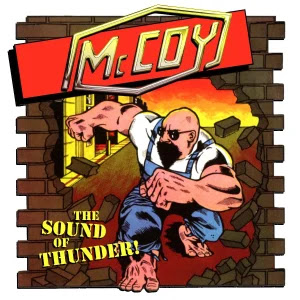
McCoy - The Sound Of Thunder!

Although primarily known as a bassist, John McCoy got his start in the mid-sixties as lead guitarist for the beat group The Drovers.  Over the ensuing years he worked as a session musician with a multitude of big names, played with the likes of folk rockers Curtiss Maldoon, jazz rockers Zzebra and Atomic Rooster, and also worked as a producer for many artists including Samson and UK Subs.  From the band’s inception in 1978 until its dissolution in 1982, he was a member of former Deep Purple vocalist Ian Gillan’s band Gillan, where in addition to playing bass, he also contributed a lot to the songwriting, arranging and producing.  When Gillan decided to end the band, he said it was because he had to have vocal surgery, but two months later he announced he was joining Black Sabbath.  This was a blow to the band, but about a year later McCoy, Gillan keyboard player Colin Towns and guitarist Paul Samson, along with vocalist T-Bone Rees and drummers Ron ‘Rebel’ Matthews and Liam Genockey, formed the band McCoy and in 1983 they released an eponymous EP followed by their full-length debut Hard Thinking in 1984.  When the band decided to tour following the album’s release things went awry.  Before their first show Rees got drunk and was horrible, resulting in the promoters and agents saying he needed to be replaced.  At this same time Samson also left the band.  They were replaced for the live shows by vocalist Nikki Brooks and guitarist Mark Keen, but when the band failed to make any impact, McCoy went on to form the group Mammoth who released an album in 1989, but then also broke up.  At this point he focused more on producing, but then in 1998 he revived the McCoy name and released the album Brainstormm with Al Romano on guitars and vocals and Mike Sciotto on drums.  Now, thanks to HNE Recordings, the EP and both albums along with Live 1977, a live recording featuring the trio of McCoy, Samson and drummer Roger Hunt that was recorded in 1977, are compiled on the three CD box set The Sound Of Thunder!

Disc one kicks off with the EP and a killer cover of Fleetwood Mac’s “Oh Well!” (written by the legendary Peter Green).  It’s a hard driving cut with a strong sense of atmosphere and some solid guitar work from Samson.  Next up are “Night Lights” and “The Sound of Thunder”, a couple of great NWOBHM rockers, the first of which has a short piano section in the middle that reminds me a little of what Van Halen would do not too much later on 1984 (interestingly Rees vocals on the EP also give me Sammy Hagar vibes at times).  “Temporary Threshold Shift” is a catchy track with a hard driving chugga chugga, boogie woogie beat.  That brings us to the last track on the EP, “Because You Lied”, a slower tune full of shimmering guitar washes (a little reminiscent of Whitesnake), but with biting, very emotional lyrics directed at Gillan.
Also included on disc one is the Think Hard album, which starts with the raw, crunching guitars of the hard driving opener “Freemind”.  “The Demon Rose” is a definite standout track that finds them shifting gears a little and is somewhat laid-back with a really cool groove that is strongly reminiscent of Thin Lizzy.  With an emotional vocal performance from Rees, “Loving Lies” is the first of two strong bluesy power ballads (“Fear Of The Morning” is the other).  Driven by its galloping beat, “Hell To Play” is very Maiden-like, while “Heads Will Roll” and “Ride The Night” are more classic sounding NWOBHM tracks.  The album closes with “Jerusalem”, a midtempo rocker, fleshed out with some synths and choral vocals from Mathern Village School Choir, that unfortunately goes on a little too long and gets a little repetitive.  Disc one also contains a couple of bonus tracks with the single version of “Oh Well!” and an alternate version of “Night Lights” that sounds a lot like a demo.  

The lineup of McCoy that recorded the Brainstorm album (disc 2) started around 1991 when Samson and Thunderstick told him about playing with Al Romano on a trip to New York.  Samson said he sounded like him and he thought they might work well together.  Romano got in touch with him and also told him about vocalist Joey Belladonna who he had been working with.  They decided McCoy would write the music and then finish them with Joey and record an album.  Belladonna was still with Anthrax and they had a hit at that time with "Bring The Noise", which continued to create delays with the album.  McCoy started working out the songs with Romano and Sciotto and it reached the point where they decided to just record it themselves with Romano handling the vocals.  When Joey finally heard what they were doing he said he thought it was too AOR for him and after further delays due to McCoy's mother dying, he said he wasn't interested in finishing it. McCoy eventually completed the recordings several years later and the album was released in 1998.  While there are some similarities to the earlier releases under that name, overall, the album is much more on the melodic, and at times poppier, side.  It opens quite differently with the ethereal “Dreaming Of The Dead”, a sitar instrumental with an interesting droning undercurrent.  “Heavy Metal Cowboy” is up next and is a hard driving cut with an almost thrash like pace from the rhythm section that finds them in a more familiar territory.   The next several tracks find them sticking to the melodic rock side of things starting off with the midtempo “On And On”, which is okay but a bit on the generic side.  “Outrageous” and “Don’t Walk Away” are in the same vein, but are catchier and much better, while “I Know A Place” and “Save Me” have a bit more of a rock edge.  Along with more really good guitar work, “Streamtrain” adds a slightly funky, stomping beat to the mix, while “Bad Luck” shifts even more in a harder direction with a bit of a ragged, punky edge.  The synth-heavy power ballad “Josephine” is up next followed by “Tarot Cards”, a poppy melodic rocker with more emphasis on the synths once again.  With the exception of the occasional chant of the song’s title, “The Prophets of Doom” is a heavy, slow paced instrumental.  Closing out the album, bookended between two humorous tracks (“The List/Zoomusic/The List Continues” and “Hawaiians 2 - Electrolux 1”) that are a nod to the For Gillan Fans Only album, is “Disillusioned”, a really pretty stripped-down acoustic cut.

Disc three is from a show recorded in 1977 featuring the earliest incarnation of the band utilizing the McCoy name (to get more gigs they also moonlighted as Samson).  In addition to McCoy, the band consisted of Paul Samson on guitars and vocals and Roger Hunt on drums.  The set was recorded by the band's roadie/sound engineer at a pub call the Target in Reading, Berkshire on July 16, 1977.  Amongst the songs are five that ended up on Samson’s debut album Survivors (“Big Brother”, “Wrong Side Of Time”, “Six Foot Under” and CD reissue tracks “I Wish I Was” and “The Shuffle”, the last of which even showcases some harmonica from Samson) and covers of Jimmy Reed's "Big Boss Man" and ZZ Top's "Nasty Dogs and Funk Kings".  For the most part, the set consists of solid bluesy rockers along with some boogie woogie (the aforementioned "Six Foot Under") and a few muscular straight-ahead rockers ("Telephone", "I Wish I Was), and while the quality of the recording is rough, it is a fascinating glimpse of what was to come a few years later.  Rounded out by a CD booklet with an essay detailing the band, The Sound of Thunder! does a great job of highlighting this era of this underappreciated musician's work.   

(HNE Recordings)

Sunday, June 02, 2024

Waverly Drive - Push My Luck EP

Push My Luck is the third EP from Waverly Drive, the solo project from studio engineer, producer and multi-instrumentalist Phil Galloni.  It's a highly infectious set of tunes that draws from musical influences like indie rock, new wave, synth-pop and electropop.  Kicking the EP off is “After The Show”, a dreamy, indie pop tune with an infectious electropop beat.  The title track is up next and is a bouncy pop track with well-placed synths and some guitar work that gives it a little more of a rock edge.  The new wave influence is very strong on the next two tracks, the melancholy “Moonlight Love Song” and the up-tempo, synth heavy “Taste Of Love”, which sounds like it came straight out of the eighties.  Driven by a hypnotic, dance beat the EP ends nicely with the dreamy, somewhat melancholy "For You".  

Saturday, June 01, 2024

Various Artists - Do The Strum! Joe Meek's Girl Groups and Pop Chanteuses (1960-1966)

Do The Strum! Joe Meek's Girl Groups and Pop Chanteuses (1960-1966) is the fifth and latest release in Cherry Red Records outstanding Joe Meek’s Tea Chest Tapes series.  Unlike the previous collections, all of which focused on a specific artist, this one focuses on female vocalists and girl groups.  Over the course of three discs there are eighty-eight songs that include every known A and B side, tracks from the film Live It Up!, demos, alternate cuts and more.  While there are a few exceptions, most notably Glenda Collins (check out her great Tea Chest Tapes collection Baby It Hurts: The Holloway Road Sessions) Meek didn’t work much with female vocalists, so most of them recorded a couple of songs with him before he moved on.  

Alongside Collins, who is heavily represented with sixteen tracks, there are twenty-three vocalists or female led bands including the more prolific (Billie Davis, The Honeycombs, Eve Boswell, Gunilla Thorn and Valerie Masters), a few that had just a handful of singles (The Cameos, Judy Cannon), others that only had a song or two (Yolanda, Carol Jones, Pat Reader, Jenny Moss, The Sharades, Kim Roberts, Flip and the Datelines, Diane and the Javelines, Gerry Harlow, The Halos, Lea and Chess, June Harris, Denise Scott and the Soundsmen and Pamela Blue), and even a couple tracks where the artist remains unknown.  There is plenty of diversity throughout the three discs, with everything from beat, folk, soul, R&B, exotica, pop, death discs, garage rock and more, and as always, Meek’s distinctive creativity in the studio is in full effect.  With almost half the tracks previously unreleased this is another treasure trove from the Tea Chest Tapes that is well worth your time.  

(Cherry Red Records

Sunday, May 26, 2024

Son of Man - Gaslight

Son Of Man was initially formed by guitarist George Jones and drummer Bob Richards, former members of the band Man, as a tribute to Man founder Micky Jones (George’s father).  While their plans at first were a series of tribute concerts, they eventually became a recording band, and have now released their third album, Gaslight.  The band is rounded out by Richie Galloni on vocals, Marco James on keys, and bassist Ray Jones (returning to the band after a six-year hiatus, replacing guitarist Glenn Quinn).  Largely rooted in classic rock with bits of metal, folk, blues and prog, it's a diverse, yet still very cohesive, collection of tunes.  The album opens with “Down”, which has a very strong David Gilmour guitar intro (think “Welcome To The Machine”) and then turns into a solid classic rock track with crunching guitars and a bit of a modern-day Deep Purple feel.  “Stuck” is full of AC/DC like guitar licks, but musically has more of a melodic rock edge along with great vocal harmonies.  Showcasing Galloni’s soulful vocals, “Can’t Stop Loving You” is a solid power ballad, although a bit generic, while “Far From Home” is a straight-ahead midtempo track that’s again on the more melodic side with a real eighties metal vibe, especially with the synths.  The title track is a powerhouse rocker with a darker edge and is a perfect example of all the pieces coming together.  Galloni’s vocals are strong and at times effects laden, while the guitars are at first heavier and dirtier, and about halfway through it explodes into a hard charging track that sounds like Deep Purple with a little Judas Priest thrown in.  “The 103” is their tribute to a Harley 103 and is a solid AOR rocker with more great harmonies, plenty of hooks and some nice organ fills.  Shifting gears a bit, “There Will Come A Day” is a big sounding, Native American-themed track that is actually reminiscent of The Eagles (don’t miss the harmonies), but with more great organ and occasional hints of Pink Floyd in the guitar work.  The atmospheric “Tomorrow” is a gorgeous, laid-back and dreamy track that has its own sound, but definitely takes a page from the Pink Floyd book.  Changing things up once again, “Hiding” is an extremely catchy, bluesy rocker complete with some great honky tonk piano, while the powerful epic “The Road” is a big sweeping rocker with touches of prog that is another album high point.  Closing things out is “Thanks For The Ride”, which opens with piano, strings and acoustic guitar before leading into a solid midtempo rocker that make for the perfect swansong for the album.  

(Esoteric Antenna)

Extra Arms - Radar

Originally known as Ryan Allen & His Extra Arms, the initial idea for the Extra Arms was for Allen to play all the main instruments, while friends would play the ones he couldn't.  Since then they have evolved into a full-fledged band and therefore the band name is now just His Extra Arms.  Having said that, while the core band plays on the new album, there is also a list of guest musicians.  The root of their sound on Radar is mostly hook-heavy power pop, often with a smart sense of humor lyrically, but there are also elements of indie rock, punk and even some country to keep things fresh and add a bit of diversity.  “Be Someone Else” kicks the album off and opens with some Farfisa organ and then explodes into a punchy power pop gem with a bit of an early Elvis Costello vibe.  Although still high energy and just as infectious, “Everything Disappears” and “All Good Things Take Time” are slightly more restrained (the latter is also notable for its great “na na na” chorus and the album’s first guest appearance with the interesting addition of Jessi Dills on trumpet).  “I Don’t Wanna Surrender” has a ragged Replacements like punk edge, while “Inflatable Boys” adds an eighties touch with drum machine and synth flourishes along with a great guitar solo that you can almost visualize being in an old MTV music video.  They shift gears a bit on “Space and Time”, an awesome country rock ballad that has some killer harmonies and pedal steel from guest Dave Feeny (not to lessen the other tracks, but I would love to hear them do a whole album like this).  Next up is the driving, straight-ahead anthemic “Shut ‘Em Down” followed by “Mad Dog Blue” which adds a bit of a jangly guitar and a hint of Cheap Trick.  After a short acoustic guitar intro, “Your Highness” is another infectious power pop tune, but with a bit of a gritty edge, and thanks to Matt Jones’ appearance on sax, there is a bit of a Springsteen flavor to album closer “Sit Back Up”.  Radar is an extremely solid release from start to finish and will have you bouncing your head, tapping your toes and singing along.    

(Extra Arms)


Friday, May 03, 2024

Warhorse - The Recordings 1970-1972

When original Deep Purple bassist Nick Simper left the band in 1969, he joined singer Marsha Hunt's band, but after playing some gigs that he said weren't very good and realizing that it wasn't really his musical style, he told Marsha that he was leaving the band.  She told him that he should stay as the band leader and form a new lineup and she would fire the rest of them.  He decided he would stay on and started by recruiting guitarist Ged Peck, followed by drummer Mac Poole.  He had initially asked Sweet drummer Mick Turner, but he didn't want to leave that band and suggested Poole, who interestingly enough had previously been asked by Robert Plant to join Led Zeppelin during their formation.  Prior to joining Marsha's band, Nick was playing on a BBC session with Rick Wakeman who told him if he ever formed a band that he would like to be a part, so he ended up joining along with vocalist Ashley Holt who was playing with Wakeman at the time.  At this point the band was torn between being Marsha Hunt's band and wanting to do their own thing, but that was resolved when said she was quitting because she was pregnant.  Unfortunately, a short time after the band's formation, Wakeman, who had many other things going on, was unable to make rehearsals on a regular basis.  They told him if he couldn't commit, he would have to leave.  That left them without keys, but after recording a demo they decided they really needed them, and contacted Frank Wilson, who was already in the band The Rumble.  He agreed to do the recording session, and really liked the result, deciding to leave The Rumble to join the band. They signed a licensing deal with Vertigo Records and released their self-titled album in 1970 followed by Red Sea in 1971.  Remastered versions of both albums, along with eleven bonus tracks consisting live songs and demos, are now available together with the release of The Recordings 1970-1972, 

Their debut opens with “Vulture Blood”, which starts with a church like organ and then explodes into a heavier track that has a slight Deep Purple vibe with some prog tendencies.  The progressive side of the band is in the forefront on the powerhouse “No Chance”, which also has some bluesy elements and is a very dynamic track shifting back and forth from laid-back sections to more intense ones.  “Burning” is an interesting cut that opens with an almost military like drum beat and organ, leading into a hard rocking, psychedelic swagger and a bit of a funk beat before ending with an instrumental section that really allows everyone in the band to shine.  The album’s lone single was a cover of the Easybeats “St Louis”, and while it failed to do anything with the exception of charting in Holland, it is an excellent take that’s makes for a fun listen.  It also includes a great wah wah solo and really shows just how strong Holt’s vocals were.  Somewhat reminiscent of Deep Purple (especially their song “Wring That Neck”), “Ritual” is a hard charging, bluesy rocker.  The gorgeous prog ballad “Solitude” is an epic track that at almost nine minutes is definitely one of the standout tracks here.  The album ends on a high point with “Woman of the Devil”, which starts slow and doomy (like a lighter Sabbath) then builds in intensity adding a bit of a Deep Purple feel to the mix, along with a somewhat funky beat and some great organ.  Disc one also contains five bonus cuts comprised of four live versions of album tracks and a demo of “Miss Jane”.  The live tracks are a nice addition and while they sound pretty good there are no audience noises, which would lead me to believe that maybe these were recorded live in a studio.  As for the demo of "Miss Jane", it has a loose, almost late sixties San Francisco jam band vibe, that’s an interesting change of pace for the band.  

The band played a lot of shows following the release of the debut, but somewhere in the midst of that time there were some personality conflicts and control issues that led to the departure of Peck.  He was replaced by Pete Parks from the band Black August, and this new lineup recorded their sophomore album Red Sea, which was released in 1971.  Unfortunately, the recording of the album had to be finished abruptly when part of the promised budget was pulled in the middle of recording, and while it’s another good release it’s definitely not as good as the debut.  Having said that, the album starts strongly with the Hammond organ driven title track, which also features some great guitar work from Parks.  At first, the almost eight minute “Back In Time” is a slower, heavier organ driven tune, but about halfway through it lets loose with a great guitar solo and a faster paced climax.  “Confident But Wrong” is a more mainstream R&B tinged rocker that finds them shifting gears a bit, quite possibly an attempt at airplay.  Following “Feeling Better”, a fairly generic ballad, is “Sybilla”, a catchy track that has more of a funk beat.  The instrumental “Mouthpiece” is an almost nine-minute track that gives everyone in the band a chance to show their talent, but it’s really a mess that sounds like something that should’ve been saved for the live show as opposed to an album cut.  The album closer is a cover of the Shirley Bassey song “I (Who Have Nothing)”, and while that sounds like an odd choice, it is a heavier, organ driven take with a slow, powerful and emotional groove that works really well.  Disc two contains six more bonus tracks consisting of another live version of “Ritual” and five demos that were recorded for a potential third album.  Although for the most part, they aren’t quite as heavy as before, these demos show promise for what could have been.  With it’s chugging beat and standout organ, “Bad Time” is the most radio friendly track here but is still a very catchy rocker.  “She Was My Friend” is a very emotional, soulful and bluesy ballad that is my favorite of the demos.  It’s a real shame it never reached its full potential.  The remaining three cuts all show that they still had their hard rocking side, be it “Gypsy Dancer” and “Standing Right Behind You”, both with a touch of a funk groove, or “House Of Dolls”, once again bringing to mind Deep Purple. 

Unfortunately, the budget issues during the recording of Red Sea created friction between the band and their label, causing a six-month period where they couldn't record.  They were eventually approached by an A&R person from Warner who wanted to sign them, and they had a handshake deal, but the next day an oil embargo was announced creating a fear of a vinyl shortage. Due to this he was forbidden from signing anyone new.  During this time Marc Poole also left the band to join Gong and was replaced by Barney James.  They toured and recorded more demos, but never released another album.  They did in fact have another record deal offered to them, but Holt and James were playing with Wakeman at that time and when Nick told them about the offer, they told him they were leaving the band to join Wakeman permanently, which lead to the band's end.  

(Esoteric Recordings)

Thursday, May 02, 2024

Aristo G - Overdrive

On his new EP, Overdrive, Melbourne based one man band Aristo G taps into a little bit of everything from rock, punk and pop to goth, industrial and electronic/syth rock to create an outstanding set of tunes.  The title track starts things off with a spy movie guitar leading into a super infectious electronic rock-based tune with laser beam effects and his captivating vocals that have a hint of Morrissey.  The faster, almost punk paced “Your Life Is Now” is another very synth driven electronic tune, but with more of a pop edge and vocals that are reminiscent of Michael Hutchence.  With more of an industrial beat and some killer rock guitar licks, “Love Games” could be described as electro industrial rock.  Kicking up the industrial beat a notch, closing track “Pantomime” has more great guitar work and a touch of Depeche Mode.  While it's only four tracks the EP is very impressive and shows tons of diversity, which shows great promise for his future releases.    

(Aristo G - Facebook)

Saturday, April 27, 2024

Glad - A New Tomorrow - The Glad & New Breed Recordings

The Sacramento band Glad initially got their start as a trio under the name Tim, Tom and Ron while the three members, Timothy B. Schmit, Tom Phillps and Ron Floegel, were still in school.  With the addition of George Hullin, they became The Contenders, and then in 1965 they changed it once again to The New Breed.  They released four singles under that name between 1965 and 1967.  Then for a brief moment in 1967 they shortened it to The Breed, before moving to LA, signing to the new label Equinox, changing it one last time to Glad, and releasing what would become their only album Feelin’ Glad.  Now, with the release of the outstanding A New Tomorrow - The Glad and New Breed Recordings, that album is available on CD for the first time, along with eight mono single mixes and the eight tracks that were released by The New Breed.

While the CD closes with the singles from The New Breed, I’m going to start there since that’s where it all began.  Their debut single was “Green Eye’d Woman”, an extremely catchy pop tune with a bit of an R&B swagger that ended up number one locally.  The flipside was “I’m In Love”, a very Beatles sounding Lennon and McCartney song that The Beatles never recorded but was a UK Top 20 hit for The Fourmost.  Both tracks on their sophomore single were a bit slower.  “I’ve Been Wrong Before” was a really nice sounding ballad written by Randy Newman that was a hit for Cilla Black, while “You’d Better Leave Me Be” was also laid-back, but one of their weaker songs.  The band shifted gears on single number three “Want Ad Reader”.  Influenced by The Beatles “Paperback Writer”, and featuring trombone and trumpet from Tim and George, it’s a punchy, fuzz guitar driven, garage rocker that to me was the high point of their singles.  “One More For The Good Guys” was the b-side and is a loose, psychedelic instrumental that was edited from a thirty-minute jam.  Their final single is another solid release, but it found them shifting back towards a more restrained sound.  Written by Ron Elliott and originally recorded by his band Beau Brummels, “Fine With Me” has a very hypnotic, kind of lilting groove, while “The Sound Of The Music” was more of an upbeat country rocker.  These singles were all actually quite successful locally, but they didn’t do much outside that area.  

In addition to the name change, by the time they recorded Feelin’ Glad they had also evolved with the changes in the music scene and embraced more psychedelia along with elements of the California Sound.  The album kicks off with “A New Tomorrow”, a light and sunshiny track with strong vocal harmonies and that breezy California psychedelic folk sound. “Say What You Mean” has a really strong Mama’s and Papa’s feel (especially in the vocals) with a touch of the Beach Boys and more strong harmonies along with a nice string arrangement.  The dreamy, stripped-down psychedelic “Bedtime Story” has some elements of The Beatles, while “Pickin’ Up The Pieces” has a little more of a rock edge and is loaded with hooks.  Their cover of Barry Mann and Cynthia Weil’s “Shape Of Things To Come” is a strong psychedelic rocker, but ironically Tim’s lead vocals are the only band representation as the actual musicians include guitarists James Burton and Ron Elliott (Beau Brummels), bassist Ray Pohlman, Pete Jolly on keys, drummer Frank Capp and Paul Beaver on Moog.  Tim is also the only band member on “Love Needs The World”, a beautiful ballad with a lush string arrangement from Bob Thompson.  Following “Sweet Melinda”, a midtempo rocker with that breezy California sound and a bit of a funk groove, they delve a bit more into country rock with the easygoing “Let’s Play Make Believe” and “No Ma, It Can’t Be”, the latter of which has even more emphasis on that loping country beat.  Complemented by another great string arrangement and horns, “Two Worlds” is a strong psychedelic tinged ballad.  The extremely infectious “Johnny’s Silver Ride” is a poppy rocker that is very reminiscent of The Monkees, and the album closes with “Silly Girl, a country rock acoustic ballad with some really nice organ fills that ends with a short reprise of “A New Tomorrow”.  Rounding out this collection are mono mixes of eight Glad singles and while they more often than not don’t differ that much, there are exception’s like “Pickin’ Up the Pieces” that has more of a rock edge and “Let’s Play Make Believe” that is instrumentally a little more country sounding.  

Unfortunately, when the album was finished the label sat on it for a few months causing the band to lose traction and while they played some shows in LA they weren't making as much money playing there as they were playing back home.  They also were disillusioned by the orchestration that had been added to some of the tracks, feeling it didn't represent how they sounded.  Ron became frustrated with all this and went to Nashville, before deciding to go back home to Sacramento.  Also at this time, Timothy was introduced to Richie Furay, who was forming Poco, and along with Randy Meisner auditioned for the band.  Meisner got the gig, but a few months later he left the band and Timothy joined (he later on replaced Meisner again in The Eagles).  The remaining three members along with new bassist/vocalist Andrew Samuels formed Redwing and released five albums under that name.  

(Now Sounds)

Sunday, April 21, 2024

The Wesleys - The Wesleys

Following their 2022 EP, Outside Voices, Montreal’s The Wesleys are back with this impressive, eponymous full-length debut.  Their bio mentions influences like Teenage Fanclub, The Pixies, The Replacements and The Clean, and you can definitely hear elements of these somewhat diverse bands as you make your way through the nine songs.  “Make It My Way” kicks the album off with synths and a tight, post punk tinged intro, followed by heavier surf rock flavored guitars, not unlike The Pixies, meshed with jangly guitar pop.  “A Lot To Lose” is a mesmerizing, dreamy, folk-tinged pop track that definitely brings to mind a bit of that aforementioned influence from The Clean.  Next up are “I’ve Been Waiting”, a catchy power pop track with a ragged, garage rock vibe, and the two minute “Fucked Up”, a noisier post punk track.  “25” is a faster paced tune with hooks galore, as is “You Better Believe It”, which opens with a hypnotic guitar and bass intro.  A strong contender for album highlight, “Radio Circus” is more of a melancholy slacker rock track, and lead single “Great Big Smile” is a dreamy, jangly guitar driven track with some nice synth touches.  Closing the album is the taut, angular guitar driven “Death By The Bite”.  In addition to writing everything the album was also recorded and mixed by the band, largely in their home studios, and sounds great.  


Monday, April 08, 2024

Dinosaur Jr - The Black Session - Live In Paris 1993 

For anyone unfamiliar, Black Sessions are live music performances recorded in front of an audience and broadcast on the C’est Lenoir show on the French radio station France Inter.  Initially recorded on March 2, 1993, this session from Dinosaur Jr has been remastered from the original tapes and released on coloured vinyl.  The session took place a little less than a month after the album Where You Been was released and featured original members, singer and guitarist J Mascis and drummer Murph, along with new bassist Mike Johnson.  While they only performed nine songs, they did a great job of covering all their releases to that point and also dug a little deeper at times instead of just sticking to their more popular songs.  The set opened with “Quest”, which starts like a slow dirge and has a noisy Neil Young vibe with a little Sonic Youth thrown in.  Their cover of The Cure’s “Just Like Heaven” is next and is an absolute kller track.  They give the song a great, ragged punk kick, while still maintaining all the hooks of the original.  After a long instrumental opening “Lung” kicks in with a manic pace and has a tenseness to it that almost takes your breath away, perfectly matching the lyrics.  “Freak Scene”, the super infectious single from Bug is up next and again Mascis lets loose with his guitar solo.  Side one closes out with the more melancholy “Get Me”.  The guitar on this track is a little mellower, but still plenty noisy, and really allows him to stretch out a little.  Sticking with the most recent album for another track, side B opens with the slow, somewhat pummeling sounds of “Drawerings” and another great solo from Mascis (hard to not sound redundant talking about his guitar solos when he kills it song after song). “Keep The Glove”, a bonus track from the album Bug, is actually a little more on the pop side of things and is about as bouncy and catchy as they come, but Mascis still absolutely lets loose at the end.  With Murph’s straight-ahead pounding leading the way, “Budge” is punk done the Dinosaur Jr way.  Closing out the nine-song set is “Thumb”, a gorgeous seven plus minute track that comes across like a ragged version of shoegaze with an extended guitar solo that is incredible.  The remastering on the album is outstanding and it’s easy to see why this has been a fan favorite for over thirty years.  (As the owner of a miniature horse I also have to give them bonus points for that great album cover).  

(Cherry Red Records)